
Rubber sheets are indispensable across industries, with their utility defined by core material compositions. From natural rubber to advanced synthetics and recycled variants, each type offers unique performance traits tailored to specific use cases, making material selection critical for operational efficiency and durability. Below is a detailed breakdown of common rubber sheet materials, their properties, applications, and key performance comparisons.
Key Rubber Sheet Materials: Properties & Applications
1. Natural Rubber (NR) Sheets
Derived from the latex of rubber trees, NR sheets are prized for exceptional elasticity (elongation up to 800%), high tensile strength, and superior resilience. They perform well in moderate temperatures (-50°C to 80°C) but are vulnerable to oil, ozone, and UV radiation.
- Applications: General manufacturing gaskets, conveyor belts, automotive door seals, shock absorbers, and consumer goods (e.g., rubber mats).
2. Nitrile (NBR) Sheets
A synthetic rubber made from butadiene and acrylonitrile, NBR sheets excel in oil, fuel, and chemical resistance. They offer good tensile strength and perform in temperatures ranging from -40°C to 120°C, though elasticity is lower than NR.
- Applications: Oil and gas pipelines, automotive engine gaskets, fuel hoses, industrial tanks, and food processing equipment (food-grade NBR).
3. Silicone (SI) Sheets
Known for extreme temperature resistance (-60°C to 230°C, with some grades up to 300°C), silicone sheets are non-toxic, flexible, and resistant to ozone, UV, and aging. They have moderate tensile strength and poor oil resistance.
- Applications: Aerospace components, electronics insulation, food processing machinery, medical equipment (sterilizable), and high-temperature gaskets.
4. EPDM (Ethylene Propylene Diene Monomer) Sheets
A synthetic rubber with outstanding weather, UV, and ozone resistance, EPDM sheets perform in -40°C to 150°C and are highly resistant to water, steam, and mild chemicals. They have low oil resistance but excellent durability.
- Applications: Construction waterproofing (roofs, basements), outdoor insulation, automotive window seals, swimming pool liners, and HVAC systems.
5. Neoprene (CR) Sheets
Made from chloroprene, neoprene sheets offer a balanced mix of wear resistance, flexibility, and flame retardancy. They perform in -30°C to 120°C and are resistant to ozone, UV, and mild chemicals, with moderate oil resistance.
- Applications: Industrial hoses, protective gear (gloves, waders), marine seals, anti-slip flooring, and electronic component protection.
6. Recycled Rubber Sheets
Produced from post-consumer (e.g., tires) or post-industrial rubber waste, these sheets are eco-friendly, cost-effective, and offer good wear resistance. They have lower elasticity and temperature tolerance (-20°C to 80°C) than virgin materials.
- Applications: Playground surfaces, athletic tracks, parking lot bumpers, sound insulation, and general-purpose mats.
Performance & Function Comparison
Performance Metric NR NBR SI EPDM CR Recycled
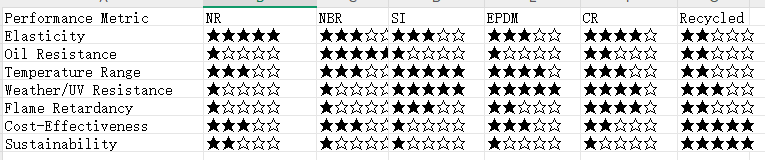
Functionally, each material addresses distinct industry needs: NR and CR prioritize flexibility for dynamic applications (e.g., shock absorption); NBR focuses on chemical/oil resistance for industrial settings; SI and EPDM excel in extreme environments (high temp/weather); and recycled rubber balances cost and sustainability for non-critical uses.
Understanding these differences ensures businesses select the right rubber sheet material to optimize performance, reduce maintenance costs, and meet industry standards. As technology advances, manufacturers continue to enhance material properties—such as improving EPDM’s oil resistance or boosting recycled rubber’s elasticity—expanding the versatility of rubber sheets across global industries.
Post time: Dec-02-2025